

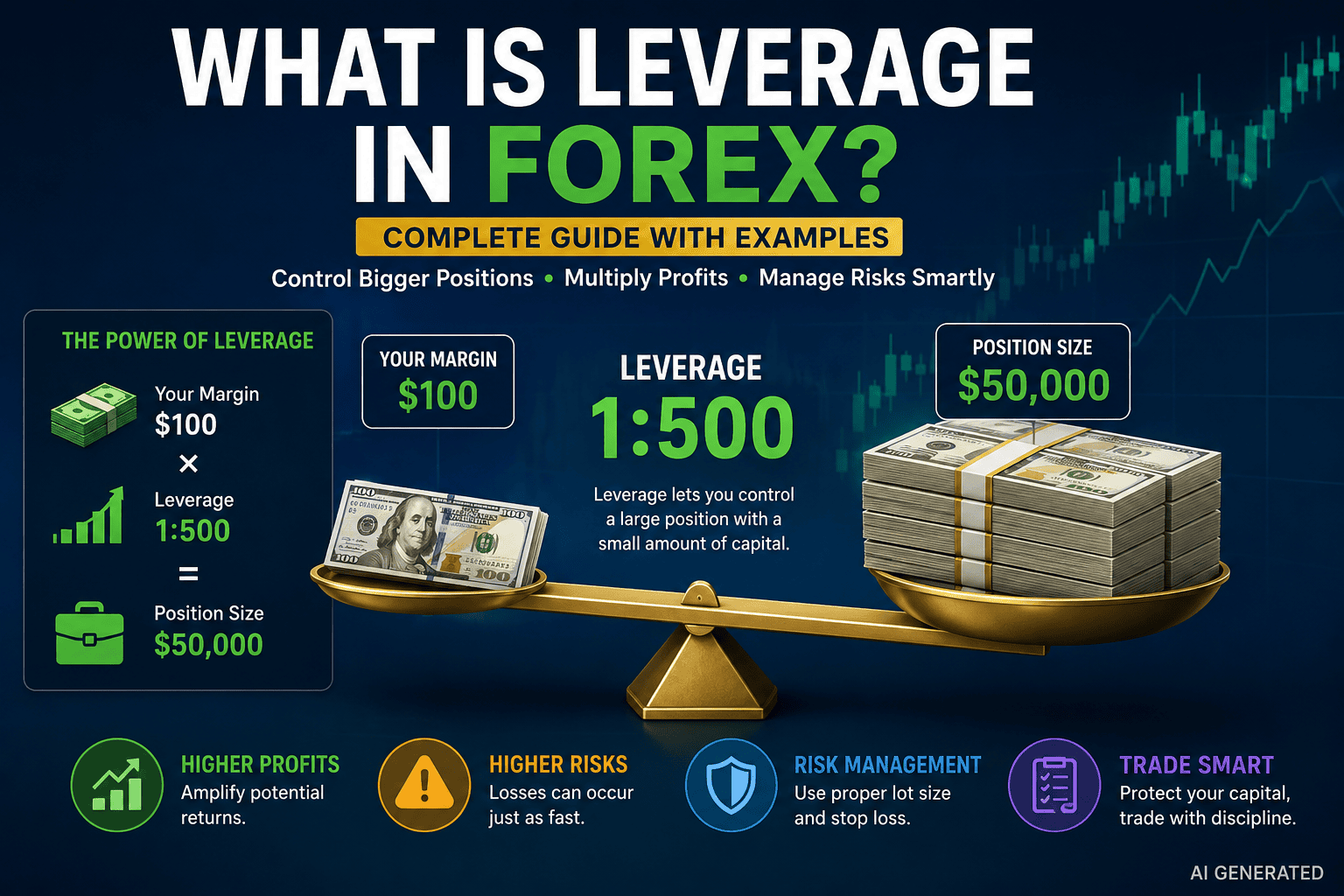
Leverage in forex trading is a broker facility that lets you control a large position with a small amount of your own money. A leverage of 1:500 means you can open a $50,000 trade with just $100 in your account. It multiplies both your profit and your loss, which is why picking the best leverage for forex trading matters more than most beginners realize.
You have probably heard traders throw around numbers like 1:100 or 1:1000 and wondered what they actually mean for your account. This guide breaks down leverage in plain terms, shows you real math with examples, and helps you pick a leverage level that matches your risk tolerance instead of wiping out your account in a week.
What Is Leverage in Forex Trading?
Leverage is borrowed capital that your broker gives you to open bigger positions than your account balance would normally allow. It is written as a ratio like 1:100 or 1:500. The first number is your capital, the second is the total position size you can control.
If your leverage is 1:100 and you deposit $500, you can open trades worth up to $50,000. Your broker is not handing you cash. It is a credit line tied to margin, and it disappears the moment you close your trade.
Leverage vs Margin
Margin is the amount of your own money locked up to open a leveraged trade. Leverage and margin are two sides of the same coin. Margin is the deposit, leverage is the multiplier applied to it.
Formula: Margin required = Trade size ÷ Leverage
Trade size: $50,000
Leverage: 1:500
Margin required: $50,000 ÷ 500 = $100
Leverage vs Lot Size vs Buying Power
These three terms get mixed up often. Here is how they differ.
| Term | What It Means | Who Sets It |
|---|---|---|
| Leverage | The ratio that decides how much margin a position requires | Your broker, based on regulation |
| Lot size | The actual size of the position you open | You, based on your risk management |
| Buying power | The maximum position size your account can currently support | Calculated from your free margin and leverage |
Leverage sets the ceiling. Lot size is the decision you make under that ceiling. Confusing the two is one of the most common beginner mistakes, covered later in this guide.
How Does Leverage Work in Forex? (Step by Step Example)
Say you want to trade one standard lot of EUR/USD, which is $100,000 in position size.
| Leverage | Margin Needed for $100,000 Position |
|---|---|
| 1:10 | $10,000 |
| 1:50 | $2,000 |
| 1:100 | $1,000 |
| 1:500 | $200 |
| 1:1000 | $100 |
This is why leveraged forex trading is so attractive to small traders. With just $200 and 1:500 leverage, you control the same $100,000 position that would otherwise need $10,000 of your own cash at 1:10.
Profit and Loss Example With Leverage
Scenario: You open one standard lot of EUR/USD (100,000 units) at 1:500 leverage. Margin used: $200.
EUR/USD moves 50 pips in your favor. Each pip value on a standard lot is about $10.
Profit: 50 pips × $10 = $500
Return on your $200 margin: 250%
Now flip it. If the market moves 50 pips against you, you lose $500 on a $200 margin deposit. Your broker will issue a margin call or close your position through a stop out before you lose more than your account allows, but the loss still hits your balance hard.
This example shows exactly why high leverage forex trading cuts both ways. The same 50 pip move that builds your account fast can also drain it fast.
Best Leverage for Forex Trading: What Should You Actually Use?
There is no single best leverage for forex trading. The right number depends on your account size, your strategy, and how much risk you can stomach without panicking.
| Trader Type | Recommended Leverage | Why |
|---|---|---|
| Beginner | 1:10 to 1:50 | Smaller position sizes, more room to survive mistakes while learning |
| Swing trader | 1:50 to 1:100 | Trades held for days need wider stops, lower leverage protects margin |
| Day trader | 1:100 to 1:200 | Tighter stops and shorter holding time allow moderate leverage |
| Scalper | 1:200 to 1:500 | Very short trades with tight stops can use higher leverage safely |
| Prop firm challenge | Set by the firm, usually 1:10 to 1:100 | Fixed by the prop firm’s risk rules, not your choice |
A simple rule that works for most traders: never let leverage push your risk per trade above 1 to 2% of your account. Leverage decides how big a position you can open. Your stop loss and lot size decide how much you actually risk.
At ForexGuru.pk, we treat leverage as access to capital, not permission to increase risk. A trader risking 1% per trade with 1:500 leverage usually survives far longer than a trader risking 10% per trade with only 1:50 leverage. The leverage number gets blamed for account losses that are really caused by oversized positions.
High Leverage Forex Broker Options: What to Know
A high leverage forex broker is generally defined as one offering more than 100:1 on major pairs like EUR/USD. Where you can access this depends heavily on regulation.
Leverage Limits by Regulator
| Regulator | Region | Max Leverage (Major Pairs) |
|---|---|---|
| NFA / CFTC | United States | 1:50 |
| FCA | United Kingdom | 1:30 |
| ESMA | European Union | 1:30 |
| ASIC | Australia | 1:30 |
| IIROC | Canada | 1:50 |
| MAS | Singapore | 1:20 |
| FSA Seychelles / IFSC Belize | Offshore | 1:500 to 1:3000 |
These strict caps trace back to regulators like ASIC and ESMA, which introduced leverage limits around 30:1 for major pairs and 20:1 for minors to protect retail traders from outsized losses. The US remains capped at 50:1 for major pairs and 20:1 for non-majors under NFA and CFTC rules.
Traders in Pakistan and other regions without strict local retail caps often use offshore-regulated brokers that offer higher leverage. Many traders around the world turn to offshore brokers advertising leverage well beyond the standard 500:1 limit found under tighter regulatory regimes.
Highest Leverage Forex Broker: Is More Always Better?
Some offshore brokers market 1:1000, 1:2000, or even 1:3000 leverage. This sounds appealing, but the highest leverage forex broker on the market is not automatically the best choice for you.
Reality check: Ultra high leverage does not increase your win rate. It only increases how fast a losing streak destroys your account. A trader using 1:2000 leverage without strict risk management can blow a $500 account in a handful of bad trades that a 1:50 account would have survived.
A well-known example of this risk in action comes from Australia, where regulators found that cutting maximum leverage led to a 91% reduction in net client losses and an 87% drop in margin close outs and negative balances within the first months of the change. High leverage magnifies outcomes in both directions, and the data shows most retail traders end up on the losing side of that magnification.
Advantages of Leverage in Forex
- Capital efficiency. You control large positions without tying up large amounts of cash.
- Diversification. Free capital can be spread across multiple pairs instead of locked in one trade.
- Access for small accounts. Traders with limited starting capital can still participate meaningfully in the forex market.
- Faster compounding. Skilled traders with tight risk control can grow small accounts quicker than in unleveraged markets.
Risks of Leverage in Forex
- Amplified losses. The same ratio that grows your profit grows your loss at the same speed.
- Margin calls. If the market moves against you, your broker can force-close positions to protect itself.
- Negative balance risk. Without negative balance protection, extreme volatility can leave you owing your broker money.
- Overtrading temptation. High leverage makes it tempting to open oversized positions that do not match your account size.
Common Leverage Mistakes Beginners Make
- Using maximum leverage on every trade. Just because 1:1000 is available does not mean every position should use it.
- Trading without a stop loss. High leverage without a stop loss turns a small adverse move into a margin call.
- Risking 10 to 20% of the account per trade. This is a fast track to a blown account within a handful of losing trades.
- Increasing lot size after a loss. Revenge trading with bigger positions to recover losses faster usually makes things worse.
- Confusing margin with account balance. Margin is what is locked up in a trade. Equity and free margin are what actually determine how much room you have left before a stop out.
How to Calculate Safe Position Size With Leverage
Use this three step method before every trade instead of guessing.
- Decide your risk per trade. Most professional traders cap this at 1 to 2% of account balance.
- Set your stop loss in pips based on the chart, not on how much leverage you have available.
- Calculate lot size: Lot size = (Account balance × Risk %) ÷ (Stop loss in pips × Pip value)
Example: $1,000 account, 1% risk = $10 risk per trade. Stop loss = 20 pips. Pip value on a mini lot = $1.
Lot size = $10 ÷ (20 × $1) = 0.5 mini lots
Notice leverage never enters this formula directly. Leverage only determines whether your margin is sufficient to open that 0.5 lot position. Risk management determines the position size itself.
Frequently Asked Questions
What leverage is best for a $100 forex account?
1:100 to 1:500 works for most small accounts, paired with strict position sizing. The leverage number matters less than keeping risk per trade under 2% regardless of how much margin is available.
Is 1:500 leverage good for beginners?
1:500 gives you flexibility with small deposits, but it is easy to misuse. Beginners often do better starting at 1:50 to 1:100 until they build discipline with stop losses and lot sizing.
Can leverage cause you to lose more than you deposit?
Yes, unless your broker offers negative balance protection. Extreme market gaps can move price past your stop loss and margin, creating a debt to the broker. Always confirm this protection exists before choosing a high leverage forex broker.
Do prop firms let you choose your own leverage?
No. Prop firms set fixed leverage as part of their risk rules, usually between 1:10 and 1:100, regardless of what you would choose on a personal account.
Why do offshore brokers offer higher leverage than regulated ones?
Offshore regulators like the FSA in Seychelles or IFSC in Belize do not enforce the same retail leverage caps as the FCA, ESMA, or ASIC. This lets offshore brokers advertise 1:500 and above, but it also usually means weaker regulatory protection for your funds.
Key Takeaway
If you remember one thing from this guide, remember this. Leverage does not decide how much you lose. Your position size does. Use leverage to improve capital efficiency, not to increase risk.
Trading forex on leverage carries a high level of risk and may not be suitable for all investors. Most retail accounts lose money trading leveraged products. This article is for educational purposes and does not constitute financial advice. Always test leverage settings on a demo account before trading live.
Reviewed by Dr. Zia-al-Hassan, ForexGuru.pk. Content checked against current regulatory sources as of July 2026.