


The forex spread is the gap between the buy price and the sell price of a currency pair. It is the main cost you pay every time you open a trade, even before the market moves in your favor. Understanding spread is one of the first things every serious trader needs to get right, because a wide spread can quietly eat your profits trade after trade.
You have probably noticed two prices next to every currency pair on your trading platform. One is slightly higher than the other. That small difference is the spread, and it works a lot like a currency exchange counter at a gold shop. The shop buys your dollars at one rate and sells dollars at a higher rate. That gap is their profit. Forex brokers use the same idea.
What Is Spread in Forex Trading?
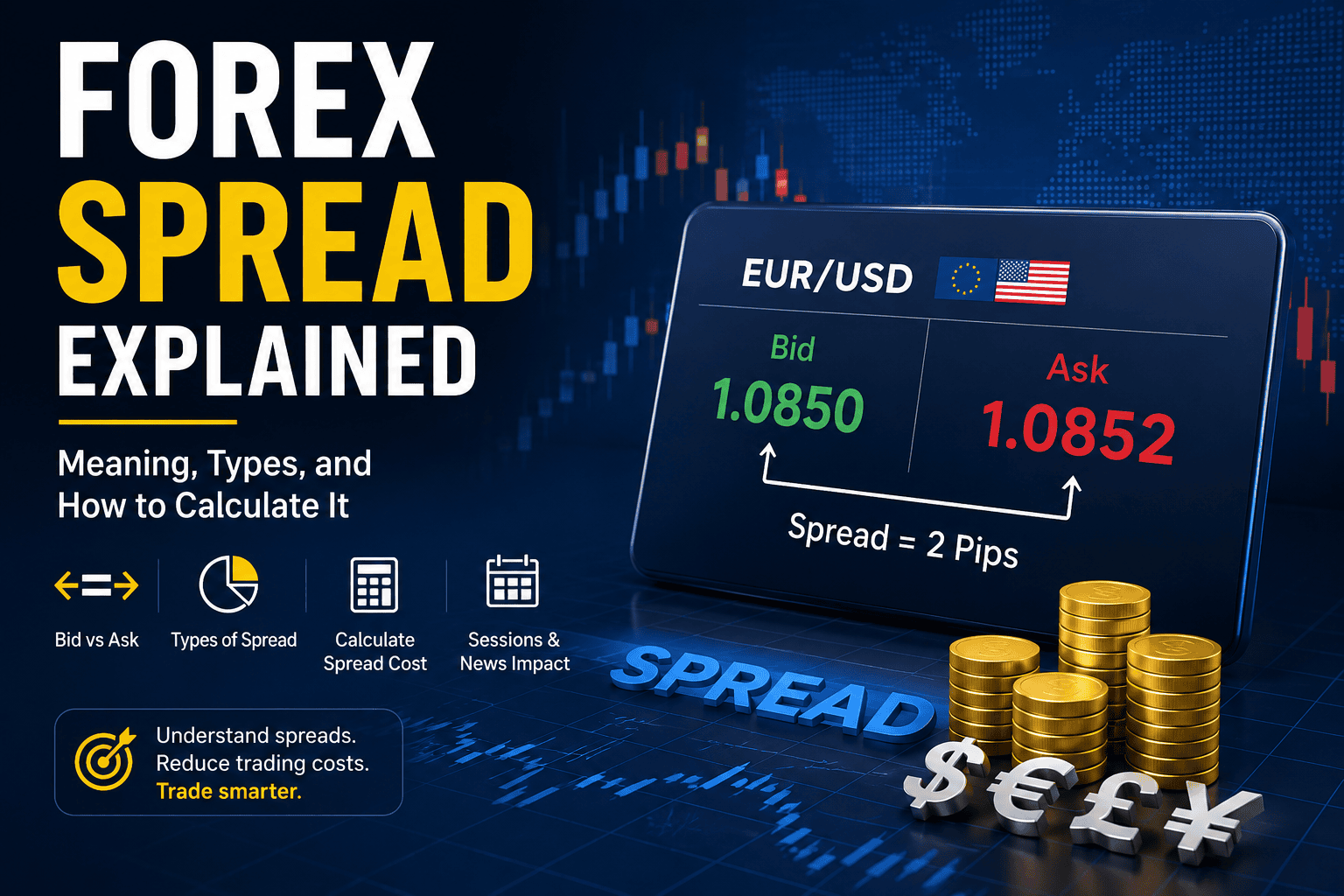
Spread is the difference between the bid price and the ask price of a currency pair. The bid is what the broker pays you to sell. The ask is what you pay the broker to buy. This gap is measured in pips, and it represents the built-in cost of every trade you place.
Formula: Spread = Ask Price − Bid Price
Example: EUR/USD shows a bid of 1.0850 and an ask of 1.0852.
Spread = 1.0852 − 1.0850 = 2 pips
This means the price needs to move 2 pips in your favor just to break even. Anything beyond that is your actual profit.
Bid Price vs Ask Price
These two terms confuse a lot of beginners, so here is a simple breakdown.
| Term | What It Means | When You Use It |
|---|---|---|
| Bid price | The price the broker pays you when you sell | Closing a buy trade, or opening a sell trade |
| Ask price | The price you pay the broker when you buy | Opening a buy trade, or closing a sell trade |
| Spread | The gap between bid and ask | Your entry cost on every trade |
Think of it like the sabzi mandi. The wholesale rate a vegetable seller pays the farmer is lower than the rate he sells to you. That markup covers his cost of doing business. A forex broker’s spread works the same way.
Types of Forex Spreads
Not every broker offers the same kind of spread. Knowing the difference helps you choose an account type that fits your trading style.
Fixed Spread
A fixed spread stays the same regardless of market conditions. It does not widen during news events or low liquidity hours. Market maker brokers usually offer this type, since they set prices internally rather than pulling them directly from the interbank market.
Variable (Floating) Spread
A variable spread changes constantly based on market liquidity and volatility. During calm hours the spread stays tight. During high-impact news like NFP, it can widen sharply within seconds. Most ECN and STP brokers use variable spreads because prices come straight from liquidity providers.
Zero Spread Accounts
Some brokers advertise a 0 pip spread. This does not mean trading is free. These accounts usually charge a separate commission per lot instead of building the cost into the spread. Always check the commission structure before assuming a 0 spread account is actually cheaper.
Warning: A broker advertising 0 pip spreads does not always offer the lowest trading cost. Always include commissions when comparing accounts.
Spread vs Commission: What’s the Difference?
Spread and commission are two different ways brokers charge you for the same service. A wider spread bundles the cost into the price you see. A commission is a separate charge added on top of a tighter, often raw spread.
Example: Broker A charges a 2 pip spread with no commission. Broker B charges a 0.2 pip spread plus $7 commission per round-turn lot. On a standard lot, Broker A costs about $20 in spread. Broker B costs about $2 in spread plus $7 commission, roughly $9 total. The commission account looks cheaper here, but this changes depending on lot size and pair, so always calculate both sides before choosing.
Neither structure is automatically better. What matters is the total cost per trade, not which single number looks smaller.
How Do Forex Brokers Actually Earn Money?
Brokers are businesses, and every business needs revenue. Understanding where that revenue comes from helps you read pricing structures instead of just accepting whatever number is advertised.
Spread is the most common revenue source. The broker marks up the raw interbank price slightly and keeps the difference. This happens on every single trade, win or lose.
Commission is a flat or per-lot fee charged separately from the spread. ECN brokers rely heavily on this model since they pass through tighter raw spreads from liquidity providers.
Swap is the overnight financing charge applied when you hold a position past the daily rollover time. It is a smaller, ongoing revenue source that only applies to positions held overnight, and it is separate from spread or commission entirely.
Most brokers combine at least two of these three. Knowing which combination your broker uses is the real way to judge whether your account is actually cheap.
How to Calculate Spread Cost in Real Money
Knowing the pip difference is not enough. You need to know what that spread actually costs you in dollars or rupees.
Formula: Spread Cost = Spread in Pips × Pip Value × Lot Size
Example: You trade 1 standard lot of EUR/USD with a 2 pip spread. Pip value on a standard lot is about $10.
Spread Cost = 2 × $10 = $20
That $20 is deducted from your account the moment you open the trade, before the market even moves. If you are scalping and opening 10 trades a day, that is $200 in spread cost alone, regardless of whether your trades win or lose. This is why understanding how leverage affects your position size matters just as much as watching the spread, since bigger positions mean bigger spread costs in real money.
Gold Example: XAU/USD often trades with a spread around 30 cents. On 1 standard lot of gold (100 ounces), each cent of movement is worth $1.
Spread Cost = 30 × $1 = $30 per trade
Gold spreads run wider than major forex pairs, so this cost adds up fast for traders who scalp gold multiple times a day.
Pro Tip: Never compare spreads during NFP or CPI announcements. Compare them during normal London or New York trading hours. That gives a fair picture of a broker’s average trading cost.
What Is a Good Spread in Forex?
There is no single number that works for every pair or every broker. Spread size depends on the currency pair, the time of day, and overall market liquidity.
| Currency Pair Type | Typical Spread Range | Why |
|---|---|---|
| Major pairs (EUR/USD, GBP/USD) | 0.5 to 2 pips | High liquidity, tightest spreads |
| Minor pairs (EUR/GBP, AUD/CAD) | 2 to 5 pips | Moderate liquidity |
| Exotic pairs (USD/PKR, USD/TRY) | 10 to 50+ pips | Low liquidity, higher risk |
| Gold (XAU/USD) | 20 to 40 cents | Depends heavily on session and volatility |
A spread under 2 pips on EUR/USD during London or New York session is considered tight. The same pair can show a wider spread during the Asian session when trading volume drops.
Why Spreads Widen: Session Timing and News Events
Spreads are not static throughout the day. They shift based on how many buyers and sellers are active in the market at any given time.
Spread Widening by Session
Liquidity drives spread size. When fewer traders are active, brokers widen spreads to protect themselves from price gaps. Pakistani traders following PKT-converted trading session times will notice spreads tighten sharply once London and New York sessions overlap, and widen again during the early Asian hours.
Spread Widening During News
High-impact news releases like NFP, interest rate decisions, or CPI data cause spreads to spike temporarily. A EUR/USD spread that normally sits at 1 pip can jump to 5 or 10 pips for a few minutes around a major announcement. This happens because liquidity providers pull back their quotes during uncertain price action.
Fixed vs Variable Spread: Which Should You Choose?
| Factor | Fixed Spread | Variable Spread |
|---|---|---|
| Predictability | High, same cost every trade | Low, changes with market conditions |
| Cost during news | Stays the same | Can widen significantly |
| Typical broker type | Market maker | ECN / STP |
| Best suited for | Beginners who want predictable costs | Traders who prioritize tighter spreads most of the time |
Neither type is universally better. A beginner placing a few trades a week may prefer the predictability of fixed spreads. An active scalper placing dozens of trades daily may prefer variable spreads that stay tight outside news hours, as long as they plan around volatility windows.
Common Mistakes Traders Make With Spread
- Ignoring spread cost when scalping. Frequent small trades add up fast when spread eats into each one.
- Trading right before major news. Spreads widen exactly when you least expect it, turning a small stop loss into a bigger loss.
- Assuming 0 spread means free trading. Commission-based accounts often cost the same or more once fees are added.
- Comparing brokers only on advertised spread. Some brokers show their lowest possible spread, not their typical spread during real trading hours.
- Not checking spread on exotic pairs. A pair like USD/PKR can carry a spread ten times wider than EUR/USD.
Common Myth About Spread
Myth: Lower spread always means a better broker.
Reality: Execution speed, slippage, commissions, and regulation matter just as much as the spread number. A broker with a slightly wider spread but fast, reliable execution can cost you less overall than a broker with a tiny spread and frequent requotes or slippage during volatile moves.
How to Choose a Broker Based on Spread
Before opening an account, check the broker’s average spread on the pairs you actually plan to trade, not just their marketing page. Reputable brokers active in Pakistan, including XM, Exness, and DooPrime, publish live spread data you can compare directly. ForexGuru.Pk has partnership arrangements with these brokers, so always compare live spread data yourself before choosing an account type.
Frequently Asked Questions
What does a 2 pip spread mean?
It means the difference between the bid and ask price on a currency pair is 2 pips. You need the market to move 2 pips in your favor just to reach break-even on that trade.
Is a lower spread always better?
Usually yes for cost, but not always for execution quality. Some brokers advertise a very low spread while adding a separate commission, or by widening spreads unpredictably during volatile periods. Always look at the total cost, not just the headline spread number.
Why is my spread wider than what the broker advertises?
Advertised spreads are often the lowest possible figure, shown during ideal liquidity conditions. Your actual spread can be wider depending on the time of day, the pair you are trading, and current market volatility.
Do ECN accounts have lower spreads?
ECN accounts typically show tighter raw spreads because prices come directly from liquidity providers, but they charge a separate commission per lot. The total cost can end up similar to a standard account with a wider spread and no commission.
Does spread affect stop loss and take profit levels?
Yes. Since the spread is the gap between bid and ask, it affects the exact price at which your stop loss or take profit triggers. This is worth remembering when calculating tight stop losses on lower timeframes.
Key Points
- Spread is the difference between the bid price and the ask price.
- Lower spreads reduce your trading cost, but execution quality matters too.
- Spreads widen during major news events and low liquidity sessions.
- ECN accounts often charge commissions separately from a tighter raw spread.
- Compare a broker’s average spread during normal hours, not just the advertised minimum.
Key Takeaway
Spread is not just a number on your screen. It is the real cost you pay to enter every trade. Compare spreads across the pairs you actually trade, check whether a broker uses fixed or variable pricing, and always account for spread cost when calculating your true profit or loss.
Spread costs vary by broker, account type, and market conditions. This article is for educational purposes and does not constitute financial advice. Always confirm live spread data directly with your broker before trading.
Reviewed by Dr. Zia-al-Hassan, Forexguru.pk.