

Most traders in Pakistan sit in front of their screen for 8 to 10 hours a day. They miss the best trades, catch the slow ones, and wonder why nothing is working. The problem is not their strategy. The problem is their timing. Trading macros are specific time windows when the market produces the strongest and most reliable moves of the day. If you understand trading macros, you stop waiting and start selecting — and your results change fast.
This guide gives you the exact trading macro times for Gold, Nasdaq, Forex pairs, Crude Oil, and Crypto — all converted to Pakistan Standard Time (PKT). No guesswork. No EST timezone confusion.
What Is a Trading Macro and How Does It Work?
A trading macro is a short time window, usually 20 to 30 minutes, when the market algorithm seeks liquidity, fills price gaps, or creates a strong directional move. These windows are not random. They repeat at the same times every trading day because the big institutions, banks, and funds all operate on the same schedule. Understanding trading macros means understanding when the market actually moves, not just when you feel like trading.
Think of it like school gate time. Between 7:30 AM and 8:00 AM, the road outside a school is quiet. From 7:55 AM to 8:10 AM, suddenly every car, van, and rickshaw is out at once. Traffic spikes. Then it calms back down. The school gate did not change. The timing of arrival did. Markets work the same way. Specific windows bring high participation, and that creates the moves worth trading.
Outside these windows, price usually drifts, chops, or does nothing meaningful. Trading in the slow hours is like trying to sell at a bazaar after it closes. The buyers have already left.
Are Trading Macros the Same as ICT Macros?
Yes. The concept of trading macros was popularized by Michael Huddleston, known online as ICT (Inner Circle Trader). He built a full framework around these time windows as part of his Smart Money Concepts (SMC) methodology. ICT macros sit inside the broader ICT system alongside tools like Fair Value Gaps (FVGs), Order Blocks, and Kill Zones.
You do not need to study the full ICT system to use trading macros. The macro times work because of how institutions operate, not because of any single teacher or methodology. Whether you call them ICT macros or trading macros, they refer to the same recurring high-probability windows. The key difference from other time-based strategies is that macros focus specifically on liquidity grabs and price inefficiencies, not just general session activity.
If you want to go deeper into how price moves and setups form during these windows, our Candlestick Patterns Master Class covers the exact patterns to look for when a trading macro window opens.
How Do Trading Sessions Work in Pakistan Time?
All trading macro times originate from New York time (ET). Pakistan is 9 hours ahead (PKT = ET + 9 hours). Most of the year this stays consistent because Pakistan does not observe daylight saving. You only need to adjust if you are following a time source from the US or UK that changes clocks seasonally — twice a year in March and November. Here are the three main sessions in PKT:
| Session | Opens (PKT) | Closes (PKT) | Best Instruments |
|---|---|---|---|
| London | 1:00 PM | 9:00 PM | GBPUSD, EURUSD, EURGBP, GBPJPY, GBPCHF |
| New York | 6:30 PM | 1:00 AM | Gold, Nasdaq, Crude Oil, USDJPY, USDCAD, Bitcoin |
| London-NY Overlap | 6:30 PM | 9:00 PM | All major pairs and commodities. Highest volume of the day. |
The London-NY overlap is where most of the money moves. It is the peak trading macro window of the entire day. Two big liquidity centres operate at the same time, foot traffic doubles, and price moves fast and decisively.
For a full foundation on how forex market timings work, visit our Advance Forex Trading Concepts course in Urdu. You can also check real-time session activity through tools at Forex Factory — one of the most used economic calendars among professional traders globally.
Best Trading Macro Times for Each Instrument in Pakistan (PKT)
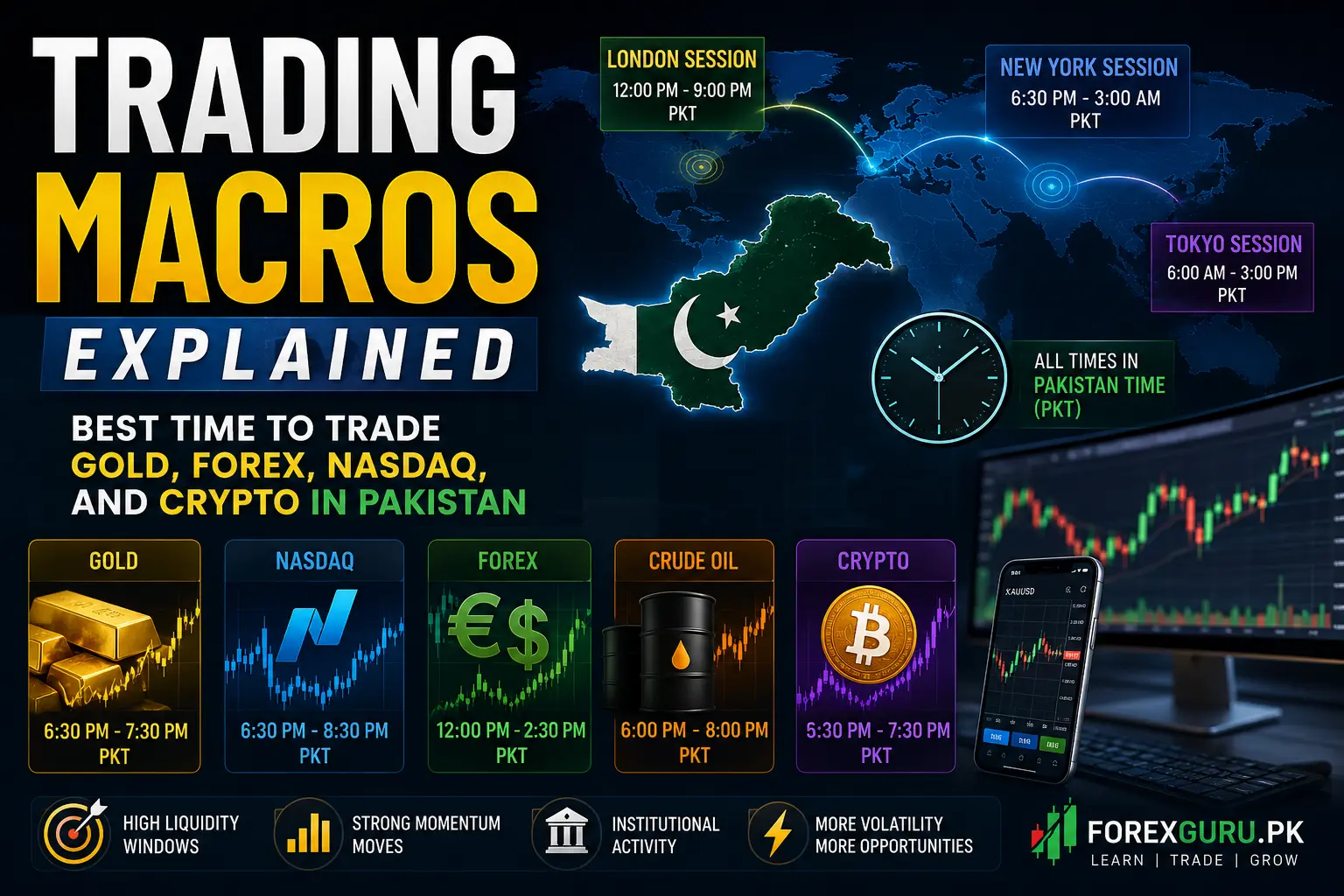
All times below are in Pakistan Standard Time (PKT). Original New York ET times are noted in brackets for reference only. These are the trading macro windows that consistently produce the strongest intraday moves across each instrument.
Gold (XAUUSD) Trading Macro Times in PKT
6:30 PM to 7:30 PM PKT [9:30 AM to 10:30 AM ET] and 11:00 PM to 11:30 PM PKT [2:00 PM to 2:30 PM ET]
The first trading macro window opens with the New York Stock Exchange. At this moment, COMEX (the US commodities exchange) becomes fully active. Dollar volume increases sharply. Institutions rebalance positions, and gold reacts fast to the shifting dollar. This is when the clearest liquidity grabs and reversals happen on XAUUSD. The second window aligns with the afternoon New York session, where momentum either continues or exhausts. Research published by TMGM Academy confirms that the 13:30 UTC (6:30 PM PKT) timestamp is the single most volatile point of the trading week when major US data releases are scheduled.
Nasdaq (NAS100) Trading Macro Times in PKT
6:30 PM to 8:00 PM PKT [9:30 AM to 11:00 AM ET] and 10:00 PM to 12:00 AM PKT [1:00 PM to 3:00 PM ET]
The NYSE open at 6:30 PM PKT is the most explosive trading macro window for Nasdaq. Large institutional orders hit the market simultaneously. Momentum is strongest in the first 90 minutes. The afternoon session (10:00 PM PKT) is where trend continuations and reversals form after the midday consolidation. Many traders in Pakistan miss the first window entirely and wonder why their Nasdaq trades drift sideways.
Crude Oil (USOIL) Trading Macro Times in PKT
6:00 PM to 8:00 PM PKT [9:00 AM to 11:00 AM ET] and 10:30 PM to 11:30 PM PKT [1:30 PM to 2:30 PM ET]
Crude Oil reacts to US inventory data released on Wednesdays at around 6:30 PM PKT — the single most impactful weekly release for Oil. Outside of inventory day, the NYSE open still produces sharp moves as dollar momentum shifts affect oil pricing directly. The afternoon window gives follow-through or trap setups after morning direction is established.
Bitcoin (BTCUSD) Trading Macro Times in PKT
5:30 PM to 6:30 PM PKT [8:30 AM to 9:30 AM ET] and 7:00 PM to 7:30 PM PKT [10:00 AM to 10:30 AM ET]
Bitcoin follows equity market liquidity patterns more than its own internal logic. Before the NYSE opens, Bitcoin often sees a liquidity sweep — price moves sharply in one direction to clear stop-losses, then reverses into the real direction. The second trading macro window (7:00 PM to 7:30 PM PKT) is the post-open expansion phase where the real move unfolds. If you have been trading Bitcoin at random hours, this is why the charts keep looking like noise.
GBPUSD, EURUSD, EURGBP, GBPJPY Macro Times in PKT
1:00 PM to 2:00 PM PKT [4:00 AM to 5:00 AM ET] and 6:30 PM to 7:30 PM PKT [9:30 AM to 10:30 AM ET]
The London open at 1:00 PM PKT kicks off the first major trading macro window for pound and euro pairs. European banks begin placing large orders, and volume picks up fast. The New York-London overlap at 6:30 PM PKT is the peak window of the entire trading day for these pairs. GBP pairs also react heavily to UK economic data which usually arrives between 12:00 PM and 1:30 PM PKT.
USDJPY and USDCAD Macro Times in PKT
4:30 PM to 6:30 PM PKT [7:30 AM to 9:30 AM ET] and 10:00 PM to 11:00 PM PKT [1:00 PM to 2:00 PM ET]
USDJPY and USDCAD both respond strongly to US economic data. Most high-impact US releases land at 6:30 PM PKT or later. The pre-market trading macro window (4:30 PM to 6:30 PM PKT) sees early positioning as traders prepare for those releases. The afternoon window gives post-release follow-through or reversal setups.
GBPCHF Macro Times in PKT
11:00 AM to 1:00 PM PKT [2:00 AM to 4:00 AM ET] and 6:00 PM to 7:30 PM PKT [9:00 AM to 10:30 AM ET]
GBPCHF is a cross pair that moves on London session momentum from the British pound side and Swiss franc volatility on the CHF side. The early trading macro window (11:00 AM PKT) captures pre-London positioning. The second window overlaps with the NY open and gives GBPCHF a strong volatility boost.
Macro Cheat Sheet: All Trading Macro Times at a Glance
| Instrument | Best Macro Window (PKT) | Session | Best For |
|---|---|---|---|
| Gold (XAUUSD) | 6:30 PM to 7:30 PM | NY Open | Reversals, liquidity grabs |
| Nasdaq (NAS100) | 6:30 PM to 8:00 PM | NYSE Open | Breakouts, momentum trades |
| Crude Oil (USOIL) | 6:00 PM to 8:00 PM | NY / Inventory | News spikes, trend moves |
| Bitcoin (BTCUSD) | 5:30 PM to 7:30 PM | Pre-NY to NY Open | Liquidity sweeps, expansion |
| GBPUSD / EURUSD / EURGBP / GBPJPY | 1:00 PM to 2:00 PM & 6:30 PM to 7:30 PM | London & Overlap | Trend continuation, reversals |
| USDJPY / USDCAD | 4:30 PM to 6:30 PM | Pre-NY to NY Open | News reactions, momentum |
| GBPCHF | 11:00 AM to 1:00 PM & 6:00 PM to 7:30 PM | Pre-London & NY Boost | London drive, volatility moves |
What Happens Inside a Trading Macro Window?
When a trading macro window opens, price usually goes through four stages. First it expands sharply in one direction. Then it pauses and consolidates. After that it retraces back partway. Finally it either reverses or continues strongly in the original direction.
Think about what happens at a bank branch when it first opens. A queue has built up outside. The moment doors open, everyone rushes in. It gets chaotic for a few minutes. Then things settle into an orderly flow. Trading macros behave the same way. The initial expansion is the rush. The consolidation is the settling. Your job is to wait for the settling before entering — not chase the initial spike.
High-Impact News Events That Change Every Trading Macro Window
Certain economic releases carry enough weight to change what happens inside a trading macro window. If one of these falls inside your window, volatility increases sharply. Sometimes the news creates the move. Sometimes it cancels the normal macro pattern entirely. Always check your calendar before entering. You can use the ForexGuru.pk Economic Calendar to track these releases. Investing.com also maintains a live economic calendar that shows all high-impact events in your local time.
Key high-impact releases and their typical PKT times:
- CPI (Consumer Price Index) — Usually 6:30 PM PKT. Moves Gold, USDJPY, and EURUSD sharply.
- PPI (Producer Price Index) — Also 6:30 PM PKT. Affects inflation expectations and dollar pairs.
- NFP (Non-Farm Payrolls) — First Friday of every month at 6:30 PM PKT. One of the biggest single-day moves of the month.
- FOMC (Federal Reserve Decision) — 8 times per year, usually 11:00 PM PKT. Affects every instrument simultaneously.
- Interest Rate Decisions — Timing varies by central bank (BOE, ECB, RBA). Check the calendar weekly.
- GDP (Gross Domestic Product) — Quarterly, 6:30 PM PKT for US GDP. Slow-moving but significant.
- PMI (Purchasing Managers Index) — Monthly. UK data around 2:30 PM to 3:00 PM PKT, US data at 6:30 PM PKT.
- Retail Sales — Monthly at 6:30 PM PKT. Directly affects consumer-linked currencies.
If one of these releases falls inside a trading macro window, do not enter before the data prints. Wait for the spread to normalize and the direction to become clear. The most common mistake is entering just as the news hits and getting caught in the whipsaw.
When Should You Not Use Trading Macros?
Knowing when to stay out is as important as knowing when to enter. Skip the trading macro window when a high-impact news event is printing inside it. Skip it when there is no clear liquidity level above or below for price to target. Skip it when the spread on your instrument is abnormally wide. For most currency pairs, the Asian session (11:00 PM to 9:00 AM PKT) produces no clean trading macro setups. Price drifts and ranges with no real institutional participation. The only exception is GBPCHF which has its early pre-London window.
If you are still learning how setups form and where to look for entries, our Chart Patterns Master Class shows exactly what to look for when a trading macro window opens.
Common Trading Macro Mistakes Pakistan Traders Make
These are the mistakes that keep traders losing even when they know the right windows.
Entering before the window opens. The trading macro itself is the reason for the setup. If you enter 10 minutes early, you are just guessing. Wait for the window to actually open before looking for your signal.
Trading every macro of the day. Not every window has a clean trade. If there is no obvious target above or below, sit out. Move to the next window. Forcing a trade is worse than missing one.
Ignoring news inside the window. If CPI or NFP prints inside your trading macro window, the normal price delivery model changes. The setup you planned may not materialize. Check the calendar first, every day.
Chasing the candle after the macro ends. Once the 20 to 30 minute window closes, the move is usually done. Entering after the window means you take the risk without the reward.
Confusing PKT and ET. Pakistan does not observe daylight saving. The US does. Twice a year — in March and November — your trading macro times shift by one hour if you are following US-based sources. Always verify at the start of each seasonal change.
How to Use Trading Macros With Your Existing Plan
Trading macros do not replace your system. They add precision to it. Start your session 15 minutes before the macro window opens. Identify the daily bias on a higher timeframe. Mark the key liquidity levels above and below current price. Wait for the trading macro window to open and watch how price reacts to those levels. Enter only when you see a clear signal. Set your stop loss beyond the liquidity level. Manage the trade as it moves.
That is the full process. The difficulty is discipline — waiting and sitting out when the setup is not clean. For a complete step-by-step foundation in forex trading, our Free Urdu Forex Training Course covers everything from basics to advanced trade management. If you need a broker that supports these instruments, visit our Forex Partners in Pakistan page.
Frequently Asked Questions About Trading Macros
What is a trading macro in simple terms?
A trading macro is a specific time window during the trading day when market moves are strongest and most predictable. These windows repeat daily because banks and institutions follow the same schedule every day.
What is the best time to trade gold (XAUUSD) in Pakistan?
The best time to trade gold in Pakistan is 6:30 PM to 7:30 PM PKT. This is the New York open when COMEX becomes fully active and dollar volume peaks. A secondary trading macro window runs from 11:00 PM to 11:30 PM PKT.
Are ICT macros and trading macros the same thing?
Yes. ICT macros and trading macros refer to the same time-based windows. ICT (Inner Circle Trader) formalized and popularized the concept. The underlying reason they work is institutional order flow, not any specific methodology.
Can I trade Nasdaq from Pakistan?
Yes. Several brokers in Pakistan offer NAS100 as a CFD instrument. The best trading macro times for Nasdaq in Pakistan are 6:30 PM to 8:00 PM PKT and 10:00 PM to 12:00 AM PKT. Check our Forex Partners page for broker options.
What happens to trading macros during CPI or NFP?
When CPI or NFP lands inside a trading macro window, the move can be much larger and faster than normal. Sometimes the macro pattern does not form at all because the news takes over price. Always check the calendar before any macro window on news days. Our Economic Calendar shows all upcoming releases in real time.
Do I need ICT knowledge to use trading macros?
No. You can use these macro windows with any existing strategy. They tell you when to look for setups, not how to find them. Start with our FAQ about Forex for a solid foundation and build from there.
What to Study Next
You now know when to trade. The next step is knowing what to look for inside those windows. Work through these in order:
- Candlestick Patterns Master Class — Learn to read what price is telling you when a trading macro window opens.
- Chart Patterns Master Class — Identify breakouts, retests, and reversals with confidence.
- Free Urdu Forex Training Course — Full foundation course from beginner to advanced concepts.
- Free Forex Services — Economic calendar, live charts, and daily analysis tools all in one place.